On the sporadic nature of recent blog posts:


Who doesn’t get discouraged, or busy, or both? There’s solace in the fact that dormancy – the gathering in of energies and their conservation for an opportune moment – always breaks.


Showing posts with label volunteers. Show all posts

Monday, December 13, 2010

A Year in Pictures: 2010

Spring

Preparing a bed for planting peas.


Judy Laushmann, Ben Knowles, Mandy Fracchione, and Kazim Ali pull weeds and harvest dandelion roots for roasted dandelion tea at the same time.

Domenico Ruggierio of Oberlin College's Multicultural Resource Center uses a broadfork to aerate soil without disturbing its profile.


The Hawken School and Cleveland Oberlin College Alumni showed up in force to prepare the fields and plant leeks!  Thanks to Matt Young of Hawken School and Kira McGirr of Cleveland OC Alums for organizing this, and thanks to all the parents, students, and alums who came out.


Springtime greenhouse:  lettuces, scallions, Chinese cabbage.


Royal Oakleaf Lettuce.


Touring Old Haunts During a Spring Trip Away from the Farm

Stonecrop Gardens, Cold Spring, NY:  A plant-lover's paradise, and where I spent a year training as a horticulturist.

Stonecrop's Gunnera tinctoria.  The Chilean Rhubarb is the largest herbaceous plant on Earth.  The tallest leaf in this picture is about 7ft tall and still growing!  Though hardy to Zone 8, gardening wizardry keeps this plant alive in Stonecrop's Zone 4 weather.

Stonecrop:  A straw Gertrude Jekyll overlooks the vegetable garden.
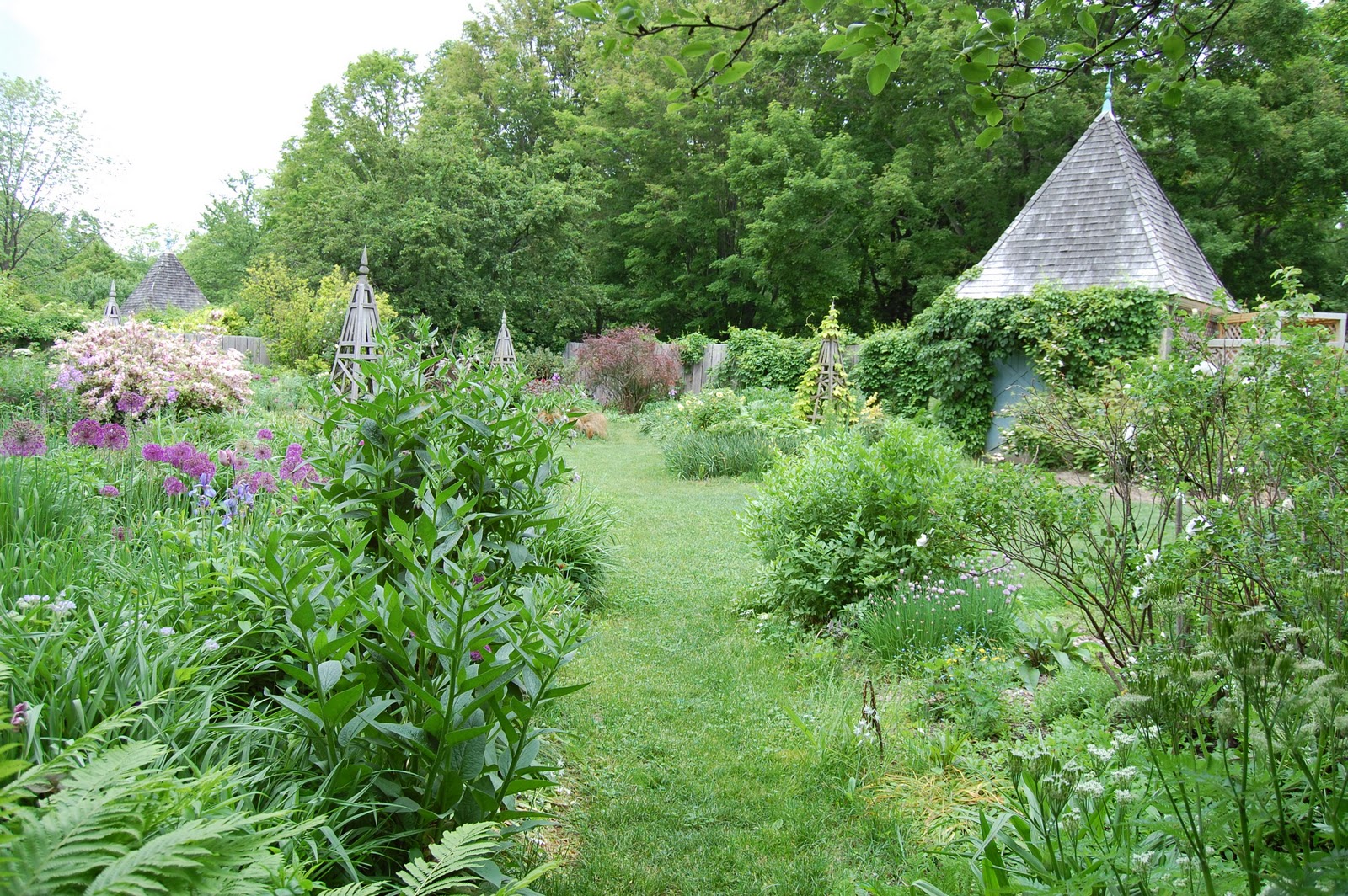

Stonecrop:  the Flower Garden.


Stonecrop:  the Gravel Garden.

Stonecrop:  The Wisteria Pavilion.

Stonecrop:  The Horticulture Library.

The Cloisters, New York, NY:  A refuge of calm in the busy city, The Cloisters is a branch museum of The Metropolitan Museum of Art dedicated to Medieval art and culture.  It is so named for the series of open courtyards that house period-style gardens.  I was a horticulturist here for three years.

Hops climbing up the Bonnefont Arcade.


Trie Cloister.


The Village Zendo, New York City:  My home temple where I have practiced Zen for 11 years.


Summer

Garlic, garlic everywhere.  Summer interns Ben Agsten, Emma Cunniff, Gabe Baldasare, Patrick Gilfeather, Assistant Grower Freed, Ian Burns, and WIlly Wickham.

Garlic:  bunching and hanging.  For the next week the strawbale building was redolent with the pungency of curing garlic, somewhat yeasty like baking bread.

Oberlin Farmers' Market Stand:  Me and Freed manning the stand.


Fall

Oberlin College Annual Day of Service:  Every year the George Jones Farm hosts new first-years who come out for a day of volunteer service as part of their orientation.

Day of Service:  Weeding a greenhouse to get it ready for fall planting.

Day of Service:  Education Coordinator/Operations Manager Evelyn Bryant and a volunteer planting lettuce.

Day of Service:  Weeding turnips and lettuce mix.

 Day of Service:  the last big project of the day was replacing the plastic on this greenhouse.
It was a team effort.

Thank OC first-years for all your help.  Welcome to Oberlin!

November Markets at the Farm

We still had lots of produce to offer.

A happy customer with her edible holiday wreath.

Monday, October 11, 2010

Everyone Poops


No one likes to talk about it, but yes, just like the title of a very great children’s book, “Everyone Poops.” There is no escaping that pooping is inextricably tied with eating, and not just in the way you’re thinking about.

This weekend a group of Oberlin College students joined me in the fields for a 10/10/10 service project. This was part of a global work-party movement on October 10, 2010 with 7000 events in 188 countries to build a carbon-neutral world.

Our project at George Jones Farm took part in age-old seasonal farm ritual. We spread manure on the fields as the season is winding down, to compost through the freezing and thawing of winter and enrich the soil for spring planting. The farm was the lucky beneficiary of two unusual local sources of this black gold: some alpacas nearby and some sheep that live in Oberlin generously donated their gifts to the fields. With pitchforks in hand we painted some of the fields with a fragrant but not malodorous mixture of manure and bedding. As with all compost, the ideal is a 50/50 mix of carbon supplied by straw, wood shavings, sawdust, or dried leaves and nitrogen from animal manure, food scraps, or any other “juicy” green plant matter. The bedding not only supplies carbon but also soaks the most valuable part of an animal’s “waste” – its urine. Urine is loaded with nitrogen and a potent fertilizer. Want to make a bold move in your own garden? Pee on it! Your plants will thrive.

That we discuss feces and urine, human or otherwise, as “waste” shows a fundamental gap in our relation with the natural and the agricultural world. As local farmer/philosopher Gene Logsdon points out in his book Holy Shit, language and culture once understood manure to be a valuable commodity. The droppings of horses pulling carriages down the roads of yore were “road apples,” to be harvested just like any other crop. In China, when one was a guest for a meal at someone’s house it was considered a matter of good manners to use the toilet after the meal. If one had after all received the gift of a meal from one’s host, one should likewise leave your host a “gift.”

Why spread manure as part of a day of service to reduce carbon emissions? Animals and plants have co-evolved into one seamless tapestry of life and the animal and bacterial processes that distill into animal manure are vital for plants’ health in the fields that can’t be fully replicated by inorganic industrial fertilizers. Poop = No factory using fossil fuels to churn out industrial fertilizers. Poop = No transportation of said fertilizers across the country. Poop on the fields = No contamination of waterways and storm drain systems. Spreading poop by hand with lots of friends = No tractor needed that day to spread the manure. Also, it was lots of fun, which is priceless. A big thanks to our student volunteers.

Monday, September 27, 2010

Farming and Transformation

Hello everyone after a very long hiatus. More on the trials and tribulations that kept me from farm blogging all summer in the near future. In the meantime:


Last week a group of high school students from Lake Ridge Academy came out to the farm for a day of community service. Having this group of strangers in front of me forced me to think about what the purpose of the George Jones Farm, or at least what I see its purpose as.
We started the day by assembling in a circle in the parking lot and introducing ourselves. When the circle wound its way to me, I introduced myself as the Farm Manager and introduced the George Jones Farm as a place that has a fourfold mission:


1. To acquaint people, especially young people, with where food comes from. Just what does a potato plant or a kale plant look like?


2. To educate about responsible ways of producing food and teach sustainable agriculture skills and to even go beyond sustainability and aim for regenerative practices that actually improve the piece of earth in our care while feeding ourselves.


3. To teach through hand-on experience how to grow one’s own food. Imagine a world where everyone is involved in growing at least some portion of their food. What would our society’s relation as a whole to food (and to farms and farmers) be then?


4. To train a new generation of farmers who will grow food not just for themselves but for the communities around them.


These goals are progressive and form a spectrum. At the least, there is something powerful about encountering food at its source for individuals who have grown up in a “de-natured” culture of supermarkets and cellophane-wrapped vegetables. At the other end are those few people who find themselves called to engage in the grueling yet satisfying work of growing food for others, of transforming air, soil, and water into tomatoes, beans, and lettuce.
That day, we performed three tasks with this high school group. We prepared lamb’s quarter and purslane greens for use in a salad mix. We thinned radish seedlings, also for salad mix and to sell as sprouts. Lastly we weeded our squash one last time. Along the way the students took the scraps from all of these projects and their lunches and fed them to the chickens.
As they boarded their bus to head back to school I thanked them for all their help and asked them to consider that the world offers itself up with abundance naturally and that we have only to recognize what is offered. We took common weeds of the fields and transformed them into elements of a delicious mesclun, boosting the salad’s nutrition. We took the problem of too many radish seedlings crowding each other out and transformed them into a high-value product full of energy and spice. And lastly, we took “waste,” stems, and apple cores, and left-overs and transformed them into eggs.
Farming is a kind of alchemy. I know that this year of farming has transformed not only weeds and waste into food, but me as well. My hope is that for the few hours they were at the farm, perhaps some of the students have left transformed as well.