Friday, November 26, 2010
Monday, November 22, 2010
The Sky is Falling
In the summer sweat almost steams off our bodies in the fields, heat mirages shimmer off the asphalt, and above the treeline in the distance there is a bluish haze of forest breath licking its way up into the deeper blue of the sky. As the world heads towards the Summer Solstice, everything ascends: peas climb, foxgloves rocket up, sunflowers grow almost visibly. By summer, a world of water has filled the sky and coalesced into massive towers of cloud. Like a flywheel whose momentum slips past the force that set it in motion, thunderstorms erupt and downpours within a day steam back up into a muggy saturated atmosphere only to break again and again like waves against the surface of the earth.
But for the past month the wheel is slowing; the summer sky is falling to the ground. The nights have chilled and in the mornings frost brocades have adorned the ground. By 10 am they're gone with the sun, but each morning they have been appearing and remaining with more insistence. Today there was a long drenching rain, and though there was some thunder it was limpid and resigned compared to its summer cousins. If summer is the high time of cumulus, autumn is a descending time of seeds scattering to earth and leaves falling, and winter is the low time of morning frosts and snow drifts.

In a zendo a suspended wooden block is struck with a gnarled branch and it rings out over the course of several minutes in a series of quickening hits. This is the han, used for calling practitioners to meditation and in the evening struck again as the Evening Gatha is chanted:
Let me respectfully remind you.
Life and death are of supreme importance.
Time swiftly passes and opportunity is lost.
Each of should strive to awaken.
Awaken! Do not squander your life.
The han's strikes are like the cycle of water rising in summer and falling in winter. There is rising and falling energy, and the striking of a balance along the course of change. The han has three rounds that read like a ledger or an abacus. In the first a lengthy round of 15 strikes lies on one side of a crescendo and one lonely hit lies on the other. In the second, 8 strikes are paired with two hits. In the final round, three short strikes balance on one side of the crescenedo with three short strikes on the other.
Everything ultimately quiets into balance. The activity of this life seems long at first but it, like the summer world of water in the sky, ultimately rests in equilibrium and in the ground. The water cycle pivots and while working in the fields at the farm, I find myself seeing in the collapse of all the elaborate structures of summer life (in June fireflies filled the night air, now crickets hug the ground with song) an analogue of the pivot in the rest of the world right now.
What is "permaculture?" It combines two concepts: permanence and culture. On the one side is stability, on the other activity. How can we create a realm of activity that can sustain itself indefinitely. Not in some determined, dead way but dynamically, creatively. Like the han's progression from imbalance to balance, I find myself hopeful that the economic turmoil we are lving through is really a slowing down into balance, into a permaculture.
How else to understand pears from Argentina in January but as a version of summer thunderclouds? The pear rises up in an airplane from the foothills of the Andes and comes down again to earth in New York City or Oberlin, Ohio into a supermarket. The amount of energy needed for that trip is like a discharge of lightning in the summer sky. But can we live in an eternal summer?
I come home from the farm where I work listening to NPR and there is always this curious contradictory tension or unease in a lot of financial reporting. The United States and the rest of the world finds itself in such precarious straits because people have been living beyond their means and not saving -- living from paycheck to paycheck. We are like little heat mirages on a summer road, evaporating away in a shimmer of consumerism. And yet in the next breath the radio reporter discusses the recalcitrance of the economy, unable to return to its former glory because no one -- not individuals, banks, or corporations -- is spending. No monumental thunderclouds of activity fill the sky because water (read "money" or even better, "wealth") everywhere is hugging close to the ground, near to home.
Economists everywhere decry this situation but could this be the beginning of true local economies? Rather than a summer world of extravagance, are we heading into autumn and winter? And why would that be so bad after all? Like an excited atom's electrons falling back to their ground state, or like the han in a zendo reminding everyone to wake up to "this" life -- of this human body in this moment in this place -- and live in balance, my hope is that the world is not collapsing but rather settling into billions of nooks and crannies like frost in kernels of soil. There is great work to be done there, each being at work in their own little sphere of activity.
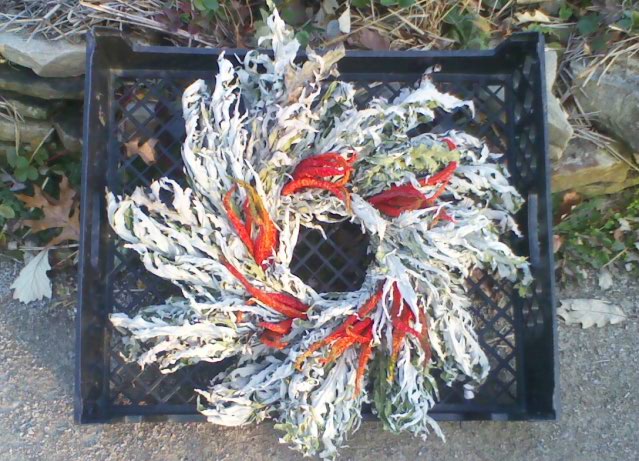
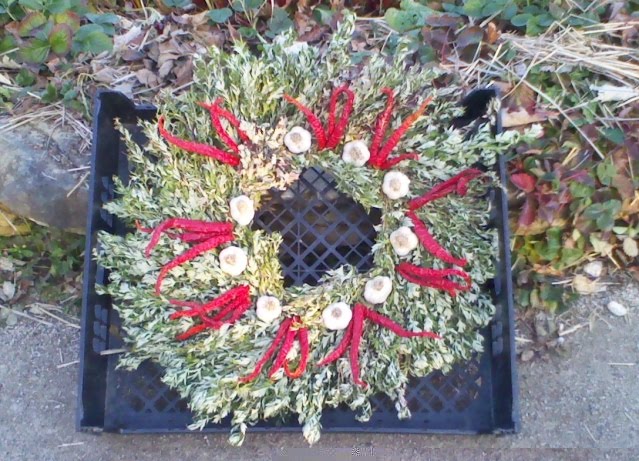
The farm this year has been poor indeed, a model of what is happening in the rest of the world. We've struggled to make ends meet. But as I've written elsewhere, I've devoted a lot of time to harvesting wild foods and expanding the repertoire of what my small community thinks food is. We've dried herbs and dehydrated vegetables as a way of extending the harvest. An open eye allows artichoke leaves and mugwort stems to be transformed into beautiful holiday wreaths laced with cayenne peppers and garlic.
Hunger is a powerful motivator for living a full life and waking up to all that is around you. Summer can often be a time of drowsiness, but the bite of winter sharpens the senses.
Saturday, October 30, 2010
Earthworm
My partner Kazim is a poet and so there are piles of books everywhere. I just stumbled across the following poem by Louise Gluck in her collection, A Village Life.
"Earthworm"
It is not sad not to be human
nor is living entirely within the earth
demeaning or empty: it is the nature of the mind
to defend its eminence, as it is the nature of those
who walk on the surface to fear its depths -- one's
position determines one's feelings. And yet
to walk on top of a thing is not to prevail over it --
it is more the opposite, a disguised dependency,
by which the slave completes the master. Likewise
the mind disdains what it can't control,
which will in turn destroy it. It is not painful to return
without language or vision: if, like the Buddhists,
one declines to leave
inventories of the self, one emerges in a space
the mind cannot conceive, being wholly physical, not
metaphoric. What is your word? Infinity, meaning
that which cannot be measured.
What is it to "[emerge] in a space/ the mind cannot conceive, being wholly physical, not/ metaphoric?" Worms in the compost piles. Humans in the outhouse at the farm. Shit and sawdust. Chinese cabbage big and heavy.
"Earthworm"
It is not sad not to be human
nor is living entirely within the earth
demeaning or empty: it is the nature of the mind
to defend its eminence, as it is the nature of those
who walk on the surface to fear its depths -- one's
position determines one's feelings. And yet
to walk on top of a thing is not to prevail over it --
it is more the opposite, a disguised dependency,
by which the slave completes the master. Likewise
the mind disdains what it can't control,
which will in turn destroy it. It is not painful to return
without language or vision: if, like the Buddhists,
one declines to leave
inventories of the self, one emerges in a space
the mind cannot conceive, being wholly physical, not
metaphoric. What is your word? Infinity, meaning
that which cannot be measured.
What is it to "[emerge] in a space/ the mind cannot conceive, being wholly physical, not/ metaphoric?" Worms in the compost piles. Humans in the outhouse at the farm. Shit and sawdust. Chinese cabbage big and heavy.
Last week I was part of a panel on faith and the environment for an Environmental Studies class at Oberlin College. I was most struck by a comment made by Prof. Jafar Mahallati, also on the panel. He spoke of how in Islam the concept of "jinns" reflects an understanding of the infinite richness and fullness of life, that even the air and fire are not empty but pulsing with unseen life just like our own. That being other than human being is not lower but simply other, alongside.
Monday, October 25, 2010
Agricultural Adventure: Encountering Real Food Beyond the Supermarket Aisles
Here is a piece I wrote for the newsletter of our last 2010 CSA (Community Supported Agriculture) distribution.
The trees are aflame with color, and though we are in the throes of a delicious Indian Summer right now, the fields are slowly going to sleep. Fall is well underway and this year is coming to a close. On behalf of all the staff here at the George Jones Farm I want to thank each of you for embarking on the agriculture adventure that this year has been, and for linking you and your family to our farm family. I know that the first half of this year was difficult, but I hope that you have been enjoying the fruits, herbs, and vegetables of the second half.
The CSA model offers the chance for a radical refiguring of our relationship to food. All of us were raised in a supermarket world that masks the trials and tribulations of weather, pests, and a million other factors that are the reality of farming with the flourescent glow and piped-in muzack of continual and unquestioned abundance. Even the seasons do not come and go in the supermarket aisles. Want a cucumber or a tomato or a pear in January in northern Ohio? No problem, whispers the supermarket genie. No matter the thousands of miles of transport under refrigeration and all the fossil fuel that entails. No matter the price of the actual taste of the food, picked green and shipped and then "ripened" with ethylene gas. No matter the wages and lives of those who slaved to grow and harvest that banana or pineapple. No matter the chemicals sprayed on plants and people in the field alike necessary to produce that archtypical "perfect" vegetable.
What the CSA offers is an encounter with the reality of your food and a partnership with the people who grow it for you. When the Summer swelters with a continual run of unusually hot days and a long run of drought, you feel it. When the Fall has been relatively mild and rains come in time, you feel that too. In spring, peas. In summer, tomatoes. In autumn, turnips.
No matter what each week has brought forth from the fields, we have been committed to making sure you have received value for your trust and investment in the farm. The CSA subscription broken down weekly comes to about $27.25. In this last week, I am happy to write that we will be offering you $40.50 worth of produce, and that over the course of the whole season we will have provided you with $716.50 worth of produce. That is a 19.4% bonus above and beyond your investment!
Over the course of the year we have been committed to bringing you not only those items of the supermarket world, but also the items of this world, the world of the fields and the woods and the wetlands of this farm. This has included a wide variety of wild edible greens in our salad mix like stellaria, red amaranth, spring cress, and wild spinach. We offered healthful cooking greens like lamb's quarters and buckwheat greens. We brought you a chance to taste flavors from other parts of the world like gobo (burdock), Chinese cabbage, and Catalan onions. And we brought you the "exotic" flavor of cattails from our own backyard and Native American foodways. I hope you have enjoyed, if not the taste, then at least the adventure of exploring how to cook with these unusual items. I do feel that part of the revolution in society that sustainable and regenerative agriculture is participating in includes expanding our culinary minds beyond those supermarket aisles.
Again, I want to thank you so much for traveling this agricultural road with us this year, and I hope you will join us again in the future. In the meantime, please find us next Saturday at the Oberlin Farmers' Market in the public library parking lot and the following Saturday on Tappan Square at the Local Foods Fest. And stay tuned for more opportunities in November and December to purchase fresh, sustainably grown produce from the George Jones Farm.
The trees are aflame with color, and though we are in the throes of a delicious Indian Summer right now, the fields are slowly going to sleep. Fall is well underway and this year is coming to a close. On behalf of all the staff here at the George Jones Farm I want to thank each of you for embarking on the agriculture adventure that this year has been, and for linking you and your family to our farm family. I know that the first half of this year was difficult, but I hope that you have been enjoying the fruits, herbs, and vegetables of the second half.
The CSA model offers the chance for a radical refiguring of our relationship to food. All of us were raised in a supermarket world that masks the trials and tribulations of weather, pests, and a million other factors that are the reality of farming with the flourescent glow and piped-in muzack of continual and unquestioned abundance. Even the seasons do not come and go in the supermarket aisles. Want a cucumber or a tomato or a pear in January in northern Ohio? No problem, whispers the supermarket genie. No matter the thousands of miles of transport under refrigeration and all the fossil fuel that entails. No matter the price of the actual taste of the food, picked green and shipped and then "ripened" with ethylene gas. No matter the wages and lives of those who slaved to grow and harvest that banana or pineapple. No matter the chemicals sprayed on plants and people in the field alike necessary to produce that archtypical "perfect" vegetable.
What the CSA offers is an encounter with the reality of your food and a partnership with the people who grow it for you. When the Summer swelters with a continual run of unusually hot days and a long run of drought, you feel it. When the Fall has been relatively mild and rains come in time, you feel that too. In spring, peas. In summer, tomatoes. In autumn, turnips.
No matter what each week has brought forth from the fields, we have been committed to making sure you have received value for your trust and investment in the farm. The CSA subscription broken down weekly comes to about $27.25. In this last week, I am happy to write that we will be offering you $40.50 worth of produce, and that over the course of the whole season we will have provided you with $716.50 worth of produce. That is a 19.4% bonus above and beyond your investment!
Over the course of the year we have been committed to bringing you not only those items of the supermarket world, but also the items of this world, the world of the fields and the woods and the wetlands of this farm. This has included a wide variety of wild edible greens in our salad mix like stellaria, red amaranth, spring cress, and wild spinach. We offered healthful cooking greens like lamb's quarters and buckwheat greens. We brought you a chance to taste flavors from other parts of the world like gobo (burdock), Chinese cabbage, and Catalan onions. And we brought you the "exotic" flavor of cattails from our own backyard and Native American foodways. I hope you have enjoyed, if not the taste, then at least the adventure of exploring how to cook with these unusual items. I do feel that part of the revolution in society that sustainable and regenerative agriculture is participating in includes expanding our culinary minds beyond those supermarket aisles.
Again, I want to thank you so much for traveling this agricultural road with us this year, and I hope you will join us again in the future. In the meantime, please find us next Saturday at the Oberlin Farmers' Market in the public library parking lot and the following Saturday on Tappan Square at the Local Foods Fest. And stay tuned for more opportunities in November and December to purchase fresh, sustainably grown produce from the George Jones Farm.
Labels:
CSA,
George Jones Farm,
supermarkets
Saturday, October 23, 2010
Wild and Terrible
And then one morning the great horned owl arrived...


When one of the farm's interns Rachel went to open our "chook dome," an Australian design for a portable chicken coop, she was shocked to find the lifeless bodies of half of the birds inside bloody and strewn about and the other half of the birds visibly stressed and anxious. It took her a few minutes, but the even bigger shock came when she noticed there inside the coop, still and silent, was the author of the carnage, a massive great horned owl about the size of a turkey. How the owl got in and why it was still there in the morning we still don't quite understand, as the coop had been shut up tight, and clearly the owl didn't know how to get out once it got in.The stuff of horror movies, imagine being one of the surviving chickens having to pass the night in the confines of the coop with the serial killer that just dispatched half of your sisters.
Raising animals has been a new experience for me this year, and I have a real fondness for our Golden Buff chickens. One of my cats at home, Genji, makes little clucking sounds, so we call him "chicken," and over the course of the year that affection has flowed back to the chickens at the farm. Opening up their coop in the morning, putting them to bed at night, I have come to call them by one of the other nicknames of our cats,"baachis" -- "daughters" in Urdu --and pick them up and stroke their soft feathers. We have had a number of predator incidents this year. Down from 40 birds to 14, the victims of racoons, hawks, and now an owl. It is not easy each time we lose a "baachi" but at the same time there is a wild beauty in the penetrating stare of that owl and a deep recognition that everything must eat and be eaten in turn.
Labels:
chickens,
foraging,
mushrooms,
wild foods
Monday, October 11, 2010
Everyone Poops

No one likes to talk about it, but yes, just like the title of a very great children’s book, “Everyone Poops.” There is no escaping that pooping is inextricably tied with eating, and not just in the way you’re thinking about.
This weekend a group of Oberlin College students joined me in the fields for a 10/10/10 service project. This was part of a global work-party movement on October 10, 2010 with 7000 events in 188 countries to build a carbon-neutral world.
Our project at George Jones Farm took part in age-old seasonal farm ritual. We spread manure on the fields as the season is winding down, to compost through the freezing and thawing of winter and enrich the soil for spring planting. The farm was the lucky beneficiary of two unusual local sources of this black gold: some alpacas nearby and some sheep that live in Oberlin generously donated their gifts to the fields. With pitchforks in hand we painted some of the fields with a fragrant but not malodorous mixture of manure and bedding. As with all compost, the ideal is a 50/50 mix of carbon supplied by straw, wood shavings, sawdust, or dried leaves and nitrogen from animal manure, food scraps, or any other “juicy” green plant matter. The bedding not only supplies carbon but also soaks the most valuable part of an animal’s “waste” – its urine. Urine is loaded with nitrogen and a potent fertilizer. Want to make a bold move in your own garden? Pee on it! Your plants will thrive.
That we discuss feces and urine, human or otherwise, as “waste” shows a fundamental gap in our relation with the natural and the agricultural world. As local farmer/philosopher Gene Logsdon points out in his book Holy Shit, language and culture once understood manure to be a valuable commodity. The droppings of horses pulling carriages down the roads of yore were “road apples,” to be harvested just like any other crop. In China , when one was a guest for a meal at someone’s house it was considered a matter of good manners to use the toilet after the meal. If one had after all received the gift of a meal from one’s host, one should likewise leave your host a “gift.”
Why spread manure as part of a day of service to reduce carbon emissions? Animals and plants have co-evolved into one seamless tapestry of life and the animal and bacterial processes that distill into animal manure are vital for plants’ health in the fields that can’t be fully replicated by inorganic industrial fertilizers. Poop = No factory using fossil fuels to churn out industrial fertilizers. Poop = No transportation of said fertilizers across the country. Poop on the fields = No contamination of waterways and storm drain systems. Spreading poop by hand with lots of friends = No tractor needed that day to spread the manure. Also, it was lots of fun, which is priceless. A big thanks to our student volunteers.
Labels:
compost,
George Jones Farm,
manure,
Oberlin College,
volunteers
Sunday, October 3, 2010
On Failing and Letting Go

This first year as a farmer has been challenging. From a late start to the job to breakdowns of every piece of equipment in the Spring, this year has been characterized by frustration at setbacks, desperation at the mounting tasks necessary for success, and elation when even one seedling miraculously burst out of the earth. The art of farming is really timing – peas in on St. Patrick’s Day, tomatoes in on Mother’s Day. And so when the tractors on the farm were all broken, in early April we hurled ourselves at the heavy clay of our fields, weeding nearly two acres by hand and hoe (and shovel for mammoth tap roots of curly dock), then trying to draw furrows in the unbroken clay to sow peas and finally plugging them in one by one stooped over in the pouring rain with aching fingers.
This scene played out crop after crop this Spring: leeks, onions, broccoli, kale, Brussels sprouts, potatoes. All gotten into the stubborn ground with aching hands, tears, and sweat, albeit increasingly late, as each required mammoth efforts to prepare the ground for them. What satisfaction to see the peas unfurl their first fat cheerful leaves and the leek transplants thicken and grow tall, and what frustration and sadness to watch that hard work swamped by weeds as late Spring heavy rains made the fields lush with life (just not the intended life of our plans) while we were trying to catch up with planting.
What to do? Make dandelion root tea and pick dandelion greens. Make use of wild greens like lamb’s quarters, amaranth, purslane, chickweed. And yet…
As the season has progressed and our efforts have brought fruit but not always bounty, it’s been hard not to feel a failure at this enterprise. What to do with this feeling, and the stunted onions and vanished shallots, the late planted tomatoes stalled and stubbornly green in August, and the struggling cucumbers?
In the middle of summer I went to the Hudson Valley in New York to join my sangha, the Village Zendo, for a 10-day sesshin, or intensive meditation retreat. The night before my flight, after working at the farm from 7:30am to 7:30pm trying to get everything done, I returned home to pack. I folded my sitting robes and packed them with my rakusu, and pulled my oryoki bowls off the high shelf of the hutch in our dining room.
“Oryoki” means “just enough” and is the formal way one eats meals in a Zen temple. Like sitting meditation and walking meditation it is a practice and a tool for Zen students, a wake-up call. An intricately knotted cloth package holds nested black bowls, chopsticks, a spoon, a small rubber spatula (more on this in a moment), a napkin, and a drying cloth.
Three times a day after hours of concentrated silent sitting and walking, these packages are brought down by practitioners from their perches on shelves lining the zendo, or meditation hall, and carried with respect t the same seats used fro meditation. There is seamlessness from zazen to kinhin to oryoki.
Eating is an incredibly intricate and meticulous practice wrapped in ceremony. Before opening the cloth package we chant that we are actually opening the Buddha’s own bowls. Energies of wisdom and commitment and compassion are invoked as food is served. Humility and recognition of the generosity that brought food to these bowls are expressed once the bowls are filled. A small offering is set out by each participant from their bowls to feed all beings in the universe. As utensils are arranged and the first bowl, the Buddha Bowl, is held high in offering, all of the universe participates in the meal.
Food is eaten mindfully and efficiently, and when it’s done out comes the spatula. This little tool bewildered me when I first practiced oryoki. Chopsticks and spoon are licked and sucked clean, and then bowl by bowl the spatula is used to scrape up and eat every last morsel, grain or gob of food. In a meal guided by form and decorum, this sucking and scraping and licking is a radical dining move: nothing is wasted.
Hot tea is then poured into the first bowl and each participant goes to work with their spatula to clean the bowl, diligently removing any residue, then pouring into the next bowl and then the next, also cleaning the utensils along the way. The now brothy tea is then drunk: nothing is wasted. Except at this point a last swallow of this meticulous act of dishwashing is reserved and then thrown out.
For years, from my first bewildered experience of this eating ritual through growing familiarity and ease with it, what has always been most meaningful is the focus on the preciousness of food and the meticulous way in which none of it is wasted. But there at the end of the meal is the pouring out of the last of the brothy tea. At this pouring out, we chant, “The water with which I wash these bowls tastes like ambrosia. I offer it to the various spirits to satisfy them.” What is this? After doing everything possible not to waste, the temple collectively throws the last of the meal out.
Arriving at the retreat feeling like an utter failure after watching all of our herculean efforts in the fields seemingly go to waste opened for me a small window. After doing everything possible, what is left? Let go. Tip your bowl, and let the last of the tea spill out. Is this failure or is it a gift? “I offer it to the various spirits.”
In Zen there is the famous image of the enso, the dramatic sweep of ink arcing in a breath across a blank page into a circle – perfection in the moment. And yet it really isn’t. Always left open, the circle is never complete. The bowl’s rim can’t hold, our efforts never complete themselves. The perfect circle is one that spills its contents out to the world/that opens its heart to let the world pour in.
Every day in the fields is total commitment to caring for earth, coworkers, and community through environmentally sound practice, teaching and supporting, and food that graces so many people’s tables. And yet… In dollars and cents, this year has been miserable and hard. And yet… After everything the bowl tips and the remains of the meal spill out, an “offering to the various spirits to satisfy them.” Who knows what effects have spilled out from this year of hard farming? Into the earth, into the people I work with, into my small town and beyond.
Since returning to the farm from this retreat I have been focusing not only on being meticulous, on saving every piece of produce possible, but also on the gift of “failure,” on letting go of my efforts and their failures, trusting that every act is a gift whether it is saving or losing. That in fact there is no losing. Where is the bowl’s rim? When the circle is always open, is there a rim at all?
Subscribe to:
Posts (Atom)