This post is a little off-topic, but important. I hope you can take a moment or two to send out some emails. Feel free to encourage others to do so too. Thanks everyone.
The mosque where my partner Kazim's family has attended has been in the news recently because of the actions of its neighbor. He placed a sign on his front lawn reading "Bomb Makers Next Driveway" Read about it here:
http://www.npr.org/blogs/thetwo-way/2011/05/10/136185720/new-york-man-posts-bomb-making-lawn-sign-to-protest-new-mosque
I am sure that you, as I was, are shocked but maybe not surprised by such hate speech. It's clear from the article that the neighbor's beef with the mosque actually has nothing to do with ideology or politics, but rather lighting and zoning. What is scary is that the air in our country is so filled with this discourse that this man can pluck it out of for his own purposes so easily, and frankly, stupidly. Are we beginning to see the development of a climate similar to 1930s Germany, where the irresponsible discourse of hate from politicians is causing such a cultural momentum that anyone can make claims about "them," those hated Others, whoever they may be?
I don't often do this, but I felt moved to write some short emails. Might I ask you to do the same as a small gesture towards cleaning the national air of such hateful speech?
1. First to Michael Heick himself. You can find him on Facebook. Search his name and you will find a Michael Heick who attended Williamsville North. That's him. Here's the note I sent to him:
Dear Mr. Heick,
Though you may have legitimate zoning/building issues with your neighbor, the sign on your yard can only be construed as hateful, and frankly, ignorant. Do you really think your neighbors, or all Muslims everywhere, are bomb-makers? Come on now... Years from now do you think your family, children (if you have), and friends will be proud of this statement of yours? Regardless of whatever light or other issues you have with the building, is this really what you think of the people inside of the building? Consider for a moment how you would feel if your neighbor on the other side put up a sign that said "Pedophile next driveway." Not only factually untrue, but deeply hurtful... You have created a lot of hurt with a small sign. Let's hope none of those "bombmakers" gets hurt by any misguided violence unleashed by your petty sign. Then you would truly be guilty of a heinous thing.
Sincerely,
Marco Wilkinson
2. To the Amherst town supervisor, Barry Weinstein. You can find him at bweinstein@amherst.ny.us. Let him know that the rest of the world supports Amherst's commitment to religious freedom and encourage him to take a stand that more firmly proclaims Amherst is a place of tolerance and civility. Here's mine:
Dear Mr. Weinstein,
First, I'd like to congratulate you and the town of Amherst for understanding, respecting, and celebrating two pillars of American culture: religious freedom and peaceful assembly. That communities of whatever faith can come together in houses of worship is a fundamental right, is something many towns and cities in the U.S. lately have been forgetting or willfully ignoring, especially when it comes to our Muslim sisters and brothers. So, thank you to Amherst for allowing the mosque to be built.
Second, I am of course writing because of the news I am reading all the way out in Oberlin, OH. The notoriety your town has received from the actions of Michael Heick and his "Bomb Makers Next Driveway" sign is certainly not something you can be excited about. Your response as it was reported, "Inappropriate but not illegal," was tempered but also tepid. Please take a more vigorous stand. While there may be no legal recourse for removing the sign, certainly it is more than just "inappropriate." Use your bully pulpit to celebrate the diversity of your town, to decry these ignorant and hate-filled assertions by Mr. Heick. Iimagine if the sign was some anti-semitic slur in Germany in the early 1930s -- sometimes the poisonous discourse in this country around Islam feels similar.
Again, thank you for your support of religious freedom. Please stand up more forcefully to celebrate it. You have many many MANY people in your community and around the country who will stand up and celebrate with you.
Sincerely,
Marco Seiryu Wilkinson
a Zen Buddhist farmer from Ohio
Wednesday, May 11, 2011


Saturday, May 7, 2011
Wednesday, May 4, 2011
Inviting Indigenous Micro-Organisms to the Table: "The Lunchbox"
This is a more practical follow-up to the previous post, "Touching the Earth," about a natural farming workshop I participated in a month ago. So much of the processes we learned in the workshop were homely, comforting, domestic. This work is truly the work of the kitchen, of cooking, of transformation.
Bernie Glassman, Zen teacher and founder of the Zen Peacemakers, wrote a book with Rick Fields on socially engaged Buddhism called Instructions to the Cook, based on the writing of the same name by 13th century Japanese Soto Zen founder Eihei Dogen. In it Glassman reminds us repeatedly to "use all the ingredients of our life." In the Zen Peacemaker version of the precepts which practitioners take when formally becoming Buddhists, the precept traditionally translated negatively as "not being stingy" is formulated positively as "using all the ingredients of my life." How are these two renderings related, and what do they have to do with indigenous micro-organisms?
What impressed me most about the natural farming workshop was its approach of connection and mutual support of all life forms for each other. As a horticulturist I feel like much of my training privileged sterility. The best soil was a sterile one for fear of the pests and diseases that might lurk within. Most potting mixes use peat moss rather than soil as their base, not only because of its lightness but because of its antiseptic qualities. At Stonecrop Gardens we actually used rich fertile soil dredged from the bottom of a pond as part of our mix, but first it passed through a soil cooker which baked the soil to the point that anything living in it was killed. Especially when working with seedlings, "dampening off" (when fungus kills off seedlings by attacking their stems) can be an issue and my heart still leans in the direction of sterility for seedlings, but I do wonder if dampening off is really just a problem of an unbalanced ecosystem where one fungus can run rampant in a soil that is devoid of any other life.
The whole natural farming approach is to invite life in all its forms into the practice of growing food rather than keeping it out. The first step is to invite the indigenous micro-organisms (IMOs) already present in your life to dinner. Brown rice is prepared and packed into a "lunchbox" for your microscopic guests. This lunchbox can be an actual box of wood or it could be a straw basket, as long as it is porous. I used a woven basket I bought at a Chinese grocery store that I think is meant for washing rice. The rice should fill the container two-thirds full and then be covered with a porous material (kitchen towel, paper towel, etc) to allow movement of air.
 Now what is the "ingredient of my life" here? Is it the brown rice? My knowledge of this technique? My intention? Are the micro-organisms the ingredient? Am I the ingredient of the micro-organisms' lives that is being used here? Whose life?
When the lunchbox has been prepared, you should bring your gift to your neighbors' house, that is, the compost pile. Bury it in the compost pile in a sheltered site where it will not get rained on or otherwise soaked. I have a three-bin composter with lids, so I placed the "lunchbox" in there and buried it. A pile of leaves would also work.


Bernie Glassman, Zen teacher and founder of the Zen Peacemakers, wrote a book with Rick Fields on socially engaged Buddhism called Instructions to the Cook, based on the writing of the same name by 13th century Japanese Soto Zen founder Eihei Dogen. In it Glassman reminds us repeatedly to "use all the ingredients of our life." In the Zen Peacemaker version of the precepts which practitioners take when formally becoming Buddhists, the precept traditionally translated negatively as "not being stingy" is formulated positively as "using all the ingredients of my life." How are these two renderings related, and what do they have to do with indigenous micro-organisms?
What impressed me most about the natural farming workshop was its approach of connection and mutual support of all life forms for each other. As a horticulturist I feel like much of my training privileged sterility. The best soil was a sterile one for fear of the pests and diseases that might lurk within. Most potting mixes use peat moss rather than soil as their base, not only because of its lightness but because of its antiseptic qualities. At Stonecrop Gardens we actually used rich fertile soil dredged from the bottom of a pond as part of our mix, but first it passed through a soil cooker which baked the soil to the point that anything living in it was killed. Especially when working with seedlings, "dampening off" (when fungus kills off seedlings by attacking their stems) can be an issue and my heart still leans in the direction of sterility for seedlings, but I do wonder if dampening off is really just a problem of an unbalanced ecosystem where one fungus can run rampant in a soil that is devoid of any other life.
The whole natural farming approach is to invite life in all its forms into the practice of growing food rather than keeping it out. The first step is to invite the indigenous micro-organisms (IMOs) already present in your life to dinner. Brown rice is prepared and packed into a "lunchbox" for your microscopic guests. This lunchbox can be an actual box of wood or it could be a straw basket, as long as it is porous. I used a woven basket I bought at a Chinese grocery store that I think is meant for washing rice. The rice should fill the container two-thirds full and then be covered with a porous material (kitchen towel, paper towel, etc) to allow movement of air.

When the lunchbox has been prepared, you should bring your gift to your neighbors' house, that is, the compost pile. Bury it in the compost pile in a sheltered site where it will not get rained on or otherwise soaked. I have a three-bin composter with lids, so I placed the "lunchbox" in there and buried it. A pile of leaves would also work.


The organisms already present in the compost pile, the very organisms that create the "black gold" that will eventually get laid into garden beds, will flock to the meal you have prepared for them. Over the course of a week or two, depending on ambient temperature (you can add some fresh manure to the compost pile to help heat it up), the rice will be colonized by a rich array of fungi and bacteria.


When a good population of IMOs has been established, the rice will hold together as a solid mass. The white fuzz is fungal hyphae that binds it all together. Fungi, the living "internet" of the earth as Paul Stamets writes, form 40% of all the living material in healthy soils and have symbiotic relationships with over 90% of plants. Ideally the hyphae are so vigorous they can end up filling the whole empty third of the container. My first attempt at this didn't yield those results but still created a good population. White should predominate, but there may also be other colors in your culture. In this case there was a lot of green as well. I'm not sure if there was too much, but I am trusting that the underlying concept of the rightness of life versus sterility means it is OK. The fungal digestion of the rice releases a slightly sweet fermented fragrance that reminds me of miso. 

Notice the worms woven through the basket when I pulled the IMO rice culture out. The fungus will feed other organisms like the worms that have sought this initial culture out already. The worms in turn will enrich the soil with their castings and feed plants which will feed people. What will we feed? We too are part of the lunchbox, another ingredient of the life we all share together.
The mass of rice impregnated with fungus and other organisms is known as IMO #1 and is the basis for creating further preparations that will enliven garden soil. I'll write about IMO #2 soon. In the meantime, why not invite your own indigenous micro-organisms to dinner?
Wednesday, April 27, 2011
"I am doing the best I can"
In the past week Oberlin has been lucky to be visited by Gary Paul Nabhan and Bill McKibben, two amazing thinkers and activists dedicated in their own ways to confronting the realities of climate change.
I feel so lucky to have met such a kind, thoughtful, energetic man as Gary Nabhan. As both someone involved in sustainable agriculture and writing, he and my partner Kazim Ali (a poet) and I sat around and could seamlessly shift from fruit tree grafting and soil development to Agha Shahid Ali. He is for me truly a model of what an agri/cultural worker can be. Gary's work as a pollination biologist, ethnobotanist, and writer centers on preserving local foodways around the country and the world, particularly in the Southwest. He spoke at several events, describing how 16,000 regionally-specific American apple varieties in the nineteenth century have now been reduced to only 11 varieties available in supermarkets today and how climate change is creating not just shifts that will cause crops to shift geographically but sudden and dramatic weather events that could extinguish species altogether and disrupt the cultural food pathways connected to them. His latest book is Chasing Chiles: Hot Spots Along the Pepper Trail. You can learn more about his work and writing at his website and at Renewing America's Food Traditions (RAFT), a program he helped start that promotes local foods and food cultures. Ohioans: check out the Buckeye Chicken, bred right here in Ohio, and consider raising some of your own to keep one of our own local food breeds alive.
A week later Bill McKibben gave a stunningly bleak picture of what awaits us in this brave new world created by climate change that was at once rousing, activating, and hopeful. In his book Eaarth: Making a Life on a Tough New Planet, McKibben argues that climate change is not coming but is already here, that the rhetoric of having to make societal changes for our grandchildren's sakes is woefully inadequate and misses the timeliness of what is happening right now. In fact, he writes, we are now living on a planet that is fundamentally different from the one on which human culture first developed. Hence the uncanny new name for this planet: Eaarth. This means not only having to make fundamental shifts in global energy use, but also facing up to having to rethink how we can survive and thrive on this new planet -- that there needs to be a new human culture for this new world.
At his lecture, he spoke of events in two parts of the world in 2010, after he had finished writing this new book: 19 countries broke high temperature records; a string of 100+ degree days in Moscow where 100 degrees had never been recorded; major decreases in grain production in Russia; 129 degree days in Pakistan; 25% of Pakistan underwater during flooding. He made an interesting case for the need for both global and local action on climate change. While local action is fundamental, it will be useless if global changes aren't made because effects will always be global. As he said (and I can attest to from my experience of an incredibly hot summer last year in Oberlin), "It doesn't matter how good a farmer you are, you're not going to be growing food" if extreme weather makes it impossible. His 350.org global activism movement is dedicated to creating the change necessary to bring atmospheric carbon levels down to 350 parts per million (ppm), the maximum level that James Hansen, a leading climatologist, believes human civilization can survive in. Where are we now? 391 ppm.
Where will we be by 2100, even if all the government pledges made at the 2009 Copenhagen Climate Change conference are kept?
725 ppm.
At the end of sesshins, weeklong intensive Zen meditation retreats, participants are exhorted to practice diligently "as if extinguishing a fire on our heads... Like fish living in a little water, what sort of peace and tranquility can there be?" These two startling images, one of searing pain and immediacy and the other one brimming with pathos and the doom of the inevitable, have always been striking to me. But now I have to admit that I feel them more keenly. Last summer a long string of 95+ degree days and no rain made farming difficult and yields less than abundant. It seems chillingly appropriate that Gary Nabhan's and Bill McKibben's visits should be bracketed by unusually harsh and destructive weather this Spring. We had a hail storm descend out of nowhere on Oberlin just a few hours before Gary arrived, with pea-size hail turning the streets white and clattering on the roofs. They also battered the cool-crop seedlings I had been hardening off outside.


The hailstorm only lasted about 3 minutes but it came down heavy.

Just a few hours later, there is barely any evidence of the storm, except for battered radish and pea seedlings.
Bill McKibben's lecture was greeted by torrential rains, only yet another in a series of downpours this Spring that have been filled eerily with lightning given the time of year. Earlier this year my backyard (about 3/4 acre) was flooded worse than I have seen before:

I thought this would be a once-a-season event, but by the time Bill McKibben was done speaking about the increasing incidence of disruptive weather, this is what my back yard looked like:

And this is how deep it was:


Fava beans, radishes, and peas are not underwater vegetables, unless they've been flooded.
All the work I've put into building beds and sowing seeds "on time" means nothing if weather systems change. On Eaarth maybe the time for planting radishes and peas and fava beans is different than the planet I grew up on. Maybe these cool weather crops no longer have a place in a landscape where extreme spring weather doesn't offer the appropriate window of mild weather before the summer heat arrives. This is frightening. What sort of peace or tranquility can there be?
While my goal this year is to grow lots of vegetables in our yard and model a kind of micro-farm space within the suburban space of my small town, I luckily have the resources to feed myself from the supermarket. But what of the farmers in Pakistan, where 25% of the whole country was flooded? As I write this another strong storm is passing through and threatening more rain just as the lake in my backyard is slowly receding into the saturated ground. What happens if another storm comes? And another? McKibben pointed out the harsh injustice of climate change: that those who have contributed least to its causes will suffer most from its effects. And so I cast my thoughts to my Pakistani and Bangladeshi farmer brothers and sisters. And knowing the distress I feel from my relatively comfortable vantage point, I have to wonder what the future holds for all of us.
I recently watched the documentary, Dirt! and was heartened to hear the story recounted below by Wangari Maathai, who won the 2004 Nobel Peace Prize for her work planting 20 million trees throughout Africa.
For me the little hummingbird's spirit is like the Zen power of joriki, translated as "self-power." She accomplishes what she does because of her will and self-reliance. Maathai's hummingbird is a lot like the Buddha's parrot. There is a series of Buddhist stories called the Jataka tales about the many previous lives of the Buddha in which his virtues of compassion and wisdom are revealed. One of them is about a parrot whose spirit of endurance is like the hummingbird's. Which bird is the Buddha in this story: the parrot or the eagle?
Is this a story about tariki, "other power," an approach of petition to a higher power (here in the form of the golden eagle)? The being who would later become the Buddha, "the awakening one," was the little soot-covered parrot, not the resplendent god-like eagle. The added dimension that I see in the parrot's story compared to the hummingbird's is that one's self-reliant energy gets things accomplished precisely because this "self" isn't contained in just one tiny body but ripples out through small actions that beget other actions.
What can I do about climate change and the very real new world we are all living in together right now? "I am doing the best I can." Thank you for doing the best you can too.
Saturday, April 23, 2011
Seedlings!
Spring is here and it's time to plant cool crops.
I have been busy nursing seeds into seedlings since February and have a wide variety of plants for sale.


Seeds busy growing under lights.

A wide array of transplanted seedlings.


Winterbor Kale


Redbor Kale Red Russian Kale

Calendula: not just a pretty flower.
Also known as "poor man's saffron" for its ability to dye foods saffron-gold.

Poppies:
Enjoy the tissuey red flowers and then harvest the seeds from the cool seedpods for good eats.


Broccoli:
Limba, Diplomat, and Romanesco.
Romanesco is actually a greenish cauliflower that will amaze you with the fractal spirals of its head.

Fun Jen Chinese Cabbage:
An elegant upright vase-shaped Chinese cabbage with stout white ribs and chartreuse leaves. I also have more tradional Napa-style Chinese cabbages.
A happy individual plant could easily weigh in at 4-5 lbs!

Gigante d'Italia Flat-Leaf Parsley:
A burst of flavor from plants that will keep putting out fresh foliage all year long.

Cornflowers/Bachelor Buttons:
The clearest cheeriest of blue meadow flowers borne on silvery stems.

Tomatoes!
A wide variety of heirloom tomatoes, Sungold cherry tomatoes, and husk cherries are on the way, as well as basil, peppers, and eggplants.
Wednesday, April 13, 2011
Touching the Earth
This past weekend I attended a transformative workshop in Natural Farming and Indigenous Microorganisms by a fellow former George Jones Farm Manager and good friend Aaron Englander that was at once revelatory and confirming. It was full of surprises but also completely common-sense and an extension of my own learning experience in relation to the land.
In the coming days and weeks I plan on experimenting with the recipes taught at the workshop, and will likely follow up with some more practical posts on this topic of IMOs. If you have the chance to learn more about these IMO-oriented farming techniques, I would heartily recommend it. Aaron Englander is based out of New England. If you'd like more information on future workshops he may be teaching, you can contact him at aaron.englander@gmail.com.

Aaron's first foundational point was that all living things are one system. All life -- bacteria, fungi, plants, animals -- share eating, respiration, and waste as fundamental processes and accomplish these processes through each other. Thus what is healthful for one type of life is also fundamentally healthful for all others, and through this commonality life forms one system.
In Buddhist tradition the historical Buddha, Siddhartha Gautama, is said to have been born and to have immediately taken seven steps leaving blooming lotuses in each footfall, and then raised one hand up to the heavens and another down to the earth, saying "I alone am the Honored One." Who is this "I alone?" I think the answer is in this point about the commonality of all living things.
In 2002 I was training as a horticulturist at Brooklyn Botanic Garden and found myself amazed by a worm-bin outreach project in the Education department. I got to know Mary Appelhoff's (the patron saint of worms) crazy sense of humor through her seminal Worms Eat My Garbage. At the same time in my Soil Management course I learned the term "edaphon," meaning the soil as a totality of all the living organisms in it. Right at the beginning of my own training in plant ways, the ground beneath my feet was revealed to be a whole universe unto itself, or better yet a whole universe that is this universe, a coextension of all life. There are bacteria who pass their whole lives high in the atmosphere whirling in the winds and clouds (see Olivia Judson's fascinating piece in the New York Times) and there are tube worms on the ocean floor and there we are in between. My own farming intuition long before I read anything by Masanobu Fukuoka or Wes Jackson or ever heard of permaculture was to be mindful of soil as more than substrate.
During that same year of horticulture training I remember all too well mowing the lawn of the BBG's Rose Garden and having a baby rabbit run out from a bed right in front of my mower, probably startled by the noise of the engine. The blades scalped its head in half cutting right through the skull, the bright pink contents spilling out. Years later I was trained on a tractor by brush-hogging a fallow field in late summer. Like a giant lawn mower the tractor wound its way through the shoulder-high grasses while I watched grasshoppers and other insects, groundhogs and cats scurry out of the way at the last second and I remembered the rabbit I killed all those years before. I saw the ones who escaped the tractor that day, but how many didn't?
And so when I work with the soil and when I have taught students about working the soil, I remember that poor rabbit and I remember the grasshoppers who flew out of the dry grass and the groundhog's sleek fur undulating away. As with a lawn mower and a brush-hog, so with a tiller. I tell my students to think of the soil as New York City, to consider all the energy flows and work that gets done in the concentrated space of a city block: the streets and hallways and elevators, the work spaces and the living spaces, the plumbing and the architecture. Now imagine Godzilla (or better yet these days, a tsunami or a nuclear disaster) coming along and flattening a stretch of that city. It will likely get rebuilt by the survivors left on the margins, but its economy will be severely compromised and it will take a long long time to return to its former vibrancy. Now imagine Godzilla making an annual visit and demolishing that same site over and over. This is tilling. Like the relentless scalping lawn-mower blade seared in my memory or the whirring blades of the brush-hog, the tiller passes through and destroys whole systems of life in a moment.
Instead we use a broadfork to accomplish a less interventionist aerating and loosening of the soil. "Small and slow solutions" is one of David Holmgren's twelve permaculture principles, and the broadfork can represent a de-escalation of violence against the hidden (to our eyes) communities of the "edaphon." This is an economic decision, a recognition that it is in humans' own interest to minimize the damage to the soil's own economy so that it might continue to meet our needs. But in light of the recognition of the commonality of all life's needs and the unity of this system, might it not also be a moral decision? I share kinship with the slain rabbit, with the escaping grasshoppers and groundhogs, with the grasses falling under the blade. We all breathe. We all breathe together. Who is this "I" and how is it "honored?"

In 2002 using worms to create compost was revolutionary to me. It was a recognition of a connection to something so unconsidered and alien as an eyeless limbless worm in the ground. That same year I learned about fungal mycorrhizae and their symbiotic existence with over 90% of plants, extending plants' nutrient uptake through an "internet" of hyphae as Paul Stamets puts it in Mycelium Running. It brought home the fiction of separateness, that living things are really always living communities of mutual support.
Like embracing worms and vermiculture as a workforce and a technology as partners in the act of composting, and like embracing mycorrhizae as a fact of the lifeways of plants and their production, and like embracing the broadfork over the tiller as a way of protecting the life of the soil, this workshop simply pushed the envelope of consideration a little further. In Worms Eat My Garbage, Mary Appelhoff has a delightful cartoon of a board meeting of soil decomposers. Her book and the vermiculture movement it spawned focused on the worms at the table. This workshop simply reminded us all that all the invisible members at the table should also be kept in consideration, cultivated, and embraced as partners in life. Ultimately, all that the Natural Farming workshop pointed to was to stay awake to all facets of the edaphon, to not forget any element in the system of breathing life.
Like raising worms in a bin in a basement or a cupboard, the workshop taught a series of recipes for cultivating the microorganisms indigenous to one's area. It's important to note the "indigenous" aspect of this, that we are already thoroughly and intimately enmeshed in a weave of life right here and now. It doesn't need to be brought from anywhere else: it's already here. The EarthStoreHouse this blog is named for is right here, the door always open. Using simple ingredients like grain and sugar and alcohol to coax and cultivate collections of these indigenous microorganisms (IMOs), we get to know the life already present in our lives and amplify it into a mixture ultimately used to "seed" life back into the soil, the ground of our lives. (Last year at the Jones Farm my goal with our aerated compost tea program was just this, to "sow life" into the fields. In a larger way it was also my mission at the farm and continues in my present education work not just to grow vegetables, but to grow farmers, to not just sow crop seeds but culture seeds as well.) It is no surprise that at each step in the amplification process, the flourishing bacteria, molds, and fungus smelled sweet and appetizing. Whiffs of miso, scents of baking bread, the sweet spiciness of curing meats. In so many ways we've come to forget that it is the eating of our microscopic kin that allows us to eat.
Through all the processes for cultivating IMOs, contact with the ground is considered important. Not only does it allow for proper breathing of the mixtures (as opposed to some non-porous surface), but more fundamentally it maintains the connection of these IMOs to their home. When the Buddha sat under the Bodhi tree, on the eve of his enlightenment, he dropped one hand and touched it to the ground, asking the earth to bear witness to his awakening. Revelatory as the concept of the "edaphon" was to me, it also has its limitations. It implies that the edaphon is a world apart from our own, a universe underground. In light of the workshop, the Buddha's touching of the earth reminds me that I am not separate from the edaphon. There is not one world above ground and another below but one "alone" to be honored. We honor it when we know that we not only touch the ground but that the converse is also true, that the earth touches us.

During the workshop we talked about a number of "groundworks" that could enhance the IMOs' abilities to help other organisms flourish. The recipes, ranging from creating a "lunchbox" of cooked rice to invite the IMOs to take up residence to mixing IMO cultures into wheat bran to fermenting weeds in brown sugar, all aimed to greet the IMOs already present and exponentially multiply their beneficial presence. On the one hand this can be seen as purely utilitarian, as yet another technology of humans to further their own ends -- in this case eating -- through the greater yields that can come from a vibrant soil. Yet on the other hand, I would return to this image of the EarthStoreHouse that has been so potent for me in my own farming practice, and see in it the collapsing of above and below ground, our world and the soil world, into the impossibly intricate interconnected system of giving and receiving, of invitation and acceptance.
We place our bundle of rice in the compost pile and invite the life that is already here supporting us to take up residence so we might nurture it. Whether we do so or not, this life is there and functioning. The fields hum with their vibrancy underfoot, the duff of the woodland churns with them already. And we too hum and churn in the system whether we know it or not. This Natural Farming approach simply offers us the chance to make a conscious awake choice to join in the "groundwork" that is always underway. In a previous post, "Who is this farmer?," this is the point I was trying to make but could not quite articulate. Whether I farm here or there, whether I farm or not at all, "farming" has gone on, is going on, and will always be going on. Who is this farmer? Who is this "I alone am the Honored One?"
One of my favorite galleries in the Metropolitan Museum of Art houses a number of large Buddhist statues. On one side of the room are the stern and self-contained arhats, or lohans, disciples of the Buddha who sit steadfast in meditation. On the other side are richly adorned and quietly smiling bodhisattvas, some of whom (like the one pictured above from the Nelson-Atkins Museum in Kansas City) are stepping out of meditation and back into the world. This stepping into the earth is stepping into the Honored One farmer's muck boots, stepping into the groundwork of bacteria, fungi, and molds, of worms and moles, of bent backs and dirty hands. Not merely stepping on the earth or even into the earth but stepping as the earth.
In the coming days and weeks I plan on experimenting with the recipes taught at the workshop, and will likely follow up with some more practical posts on this topic of IMOs. If you have the chance to learn more about these IMO-oriented farming techniques, I would heartily recommend it. Aaron Englander is based out of New England. If you'd like more information on future workshops he may be teaching, you can contact him at aaron.englander@gmail.com.
"I Alone Am the Honored One:" I All One Am Honored
Aaron's first foundational point was that all living things are one system. All life -- bacteria, fungi, plants, animals -- share eating, respiration, and waste as fundamental processes and accomplish these processes through each other. Thus what is healthful for one type of life is also fundamentally healthful for all others, and through this commonality life forms one system.
In Buddhist tradition the historical Buddha, Siddhartha Gautama, is said to have been born and to have immediately taken seven steps leaving blooming lotuses in each footfall, and then raised one hand up to the heavens and another down to the earth, saying "I alone am the Honored One." Who is this "I alone?" I think the answer is in this point about the commonality of all living things.
In 2002 I was training as a horticulturist at Brooklyn Botanic Garden and found myself amazed by a worm-bin outreach project in the Education department. I got to know Mary Appelhoff's (the patron saint of worms) crazy sense of humor through her seminal Worms Eat My Garbage. At the same time in my Soil Management course I learned the term "edaphon," meaning the soil as a totality of all the living organisms in it. Right at the beginning of my own training in plant ways, the ground beneath my feet was revealed to be a whole universe unto itself, or better yet a whole universe that is this universe, a coextension of all life. There are bacteria who pass their whole lives high in the atmosphere whirling in the winds and clouds (see Olivia Judson's fascinating piece in the New York Times) and there are tube worms on the ocean floor and there we are in between. My own farming intuition long before I read anything by Masanobu Fukuoka or Wes Jackson or ever heard of permaculture was to be mindful of soil as more than substrate.
During that same year of horticulture training I remember all too well mowing the lawn of the BBG's Rose Garden and having a baby rabbit run out from a bed right in front of my mower, probably startled by the noise of the engine. The blades scalped its head in half cutting right through the skull, the bright pink contents spilling out. Years later I was trained on a tractor by brush-hogging a fallow field in late summer. Like a giant lawn mower the tractor wound its way through the shoulder-high grasses while I watched grasshoppers and other insects, groundhogs and cats scurry out of the way at the last second and I remembered the rabbit I killed all those years before. I saw the ones who escaped the tractor that day, but how many didn't?
And so when I work with the soil and when I have taught students about working the soil, I remember that poor rabbit and I remember the grasshoppers who flew out of the dry grass and the groundhog's sleek fur undulating away. As with a lawn mower and a brush-hog, so with a tiller. I tell my students to think of the soil as New York City, to consider all the energy flows and work that gets done in the concentrated space of a city block: the streets and hallways and elevators, the work spaces and the living spaces, the plumbing and the architecture. Now imagine Godzilla (or better yet these days, a tsunami or a nuclear disaster) coming along and flattening a stretch of that city. It will likely get rebuilt by the survivors left on the margins, but its economy will be severely compromised and it will take a long long time to return to its former vibrancy. Now imagine Godzilla making an annual visit and demolishing that same site over and over. This is tilling. Like the relentless scalping lawn-mower blade seared in my memory or the whirring blades of the brush-hog, the tiller passes through and destroys whole systems of life in a moment.
Instead we use a broadfork to accomplish a less interventionist aerating and loosening of the soil. "Small and slow solutions" is one of David Holmgren's twelve permaculture principles, and the broadfork can represent a de-escalation of violence against the hidden (to our eyes) communities of the "edaphon." This is an economic decision, a recognition that it is in humans' own interest to minimize the damage to the soil's own economy so that it might continue to meet our needs. But in light of the recognition of the commonality of all life's needs and the unity of this system, might it not also be a moral decision? I share kinship with the slain rabbit, with the escaping grasshoppers and groundhogs, with the grasses falling under the blade. We all breathe. We all breathe together. Who is this "I" and how is it "honored?"
Touching the Earth
In 2002 using worms to create compost was revolutionary to me. It was a recognition of a connection to something so unconsidered and alien as an eyeless limbless worm in the ground. That same year I learned about fungal mycorrhizae and their symbiotic existence with over 90% of plants, extending plants' nutrient uptake through an "internet" of hyphae as Paul Stamets puts it in Mycelium Running. It brought home the fiction of separateness, that living things are really always living communities of mutual support.
Like embracing worms and vermiculture as a workforce and a technology as partners in the act of composting, and like embracing mycorrhizae as a fact of the lifeways of plants and their production, and like embracing the broadfork over the tiller as a way of protecting the life of the soil, this workshop simply pushed the envelope of consideration a little further. In Worms Eat My Garbage, Mary Appelhoff has a delightful cartoon of a board meeting of soil decomposers. Her book and the vermiculture movement it spawned focused on the worms at the table. This workshop simply reminded us all that all the invisible members at the table should also be kept in consideration, cultivated, and embraced as partners in life. Ultimately, all that the Natural Farming workshop pointed to was to stay awake to all facets of the edaphon, to not forget any element in the system of breathing life.
Like raising worms in a bin in a basement or a cupboard, the workshop taught a series of recipes for cultivating the microorganisms indigenous to one's area. It's important to note the "indigenous" aspect of this, that we are already thoroughly and intimately enmeshed in a weave of life right here and now. It doesn't need to be brought from anywhere else: it's already here. The EarthStoreHouse this blog is named for is right here, the door always open. Using simple ingredients like grain and sugar and alcohol to coax and cultivate collections of these indigenous microorganisms (IMOs), we get to know the life already present in our lives and amplify it into a mixture ultimately used to "seed" life back into the soil, the ground of our lives. (Last year at the Jones Farm my goal with our aerated compost tea program was just this, to "sow life" into the fields. In a larger way it was also my mission at the farm and continues in my present education work not just to grow vegetables, but to grow farmers, to not just sow crop seeds but culture seeds as well.) It is no surprise that at each step in the amplification process, the flourishing bacteria, molds, and fungus smelled sweet and appetizing. Whiffs of miso, scents of baking bread, the sweet spiciness of curing meats. In so many ways we've come to forget that it is the eating of our microscopic kin that allows us to eat.
Through all the processes for cultivating IMOs, contact with the ground is considered important. Not only does it allow for proper breathing of the mixtures (as opposed to some non-porous surface), but more fundamentally it maintains the connection of these IMOs to their home. When the Buddha sat under the Bodhi tree, on the eve of his enlightenment, he dropped one hand and touched it to the ground, asking the earth to bear witness to his awakening. Revelatory as the concept of the "edaphon" was to me, it also has its limitations. It implies that the edaphon is a world apart from our own, a universe underground. In light of the workshop, the Buddha's touching of the earth reminds me that I am not separate from the edaphon. There is not one world above ground and another below but one "alone" to be honored. We honor it when we know that we not only touch the ground but that the converse is also true, that the earth touches us.
Groundwork: Stepping As The Earth

During the workshop we talked about a number of "groundworks" that could enhance the IMOs' abilities to help other organisms flourish. The recipes, ranging from creating a "lunchbox" of cooked rice to invite the IMOs to take up residence to mixing IMO cultures into wheat bran to fermenting weeds in brown sugar, all aimed to greet the IMOs already present and exponentially multiply their beneficial presence. On the one hand this can be seen as purely utilitarian, as yet another technology of humans to further their own ends -- in this case eating -- through the greater yields that can come from a vibrant soil. Yet on the other hand, I would return to this image of the EarthStoreHouse that has been so potent for me in my own farming practice, and see in it the collapsing of above and below ground, our world and the soil world, into the impossibly intricate interconnected system of giving and receiving, of invitation and acceptance.
We place our bundle of rice in the compost pile and invite the life that is already here supporting us to take up residence so we might nurture it. Whether we do so or not, this life is there and functioning. The fields hum with their vibrancy underfoot, the duff of the woodland churns with them already. And we too hum and churn in the system whether we know it or not. This Natural Farming approach simply offers us the chance to make a conscious awake choice to join in the "groundwork" that is always underway. In a previous post, "Who is this farmer?," this is the point I was trying to make but could not quite articulate. Whether I farm here or there, whether I farm or not at all, "farming" has gone on, is going on, and will always be going on. Who is this farmer? Who is this "I alone am the Honored One?"
One of my favorite galleries in the Metropolitan Museum of Art houses a number of large Buddhist statues. On one side of the room are the stern and self-contained arhats, or lohans, disciples of the Buddha who sit steadfast in meditation. On the other side are richly adorned and quietly smiling bodhisattvas, some of whom (like the one pictured above from the Nelson-Atkins Museum in Kansas City) are stepping out of meditation and back into the world. This stepping into the earth is stepping into the Honored One farmer's muck boots, stepping into the groundwork of bacteria, fungi, and molds, of worms and moles, of bent backs and dirty hands. Not merely stepping on the earth or even into the earth but stepping as the earth.
Friday, April 1, 2011
Unsealing and Sealing
I couldn't wait, but probably should have.
Armies of seedlings have overwhelmed my shelves of grow lights indoors. Cabbage, chinese cabbage, kale, claendula, broccoli, parsley, lettuce, cauliflower. Busting out of seed trays jostling under the fluorescent tubes, or pricked out and standing in orderly ranks of 72 or 128.
And each day the sun grows stronger. Driving down the road I have to crack the windows to let some air lest I roast. That delicious bracing air that is beginning to smell of damp soil and life. These bracing early spring days reach the 30s and 40s, and the breezy air flows around you with that same quality of melting ice: a cooling fire, a liquid burning cold.
With more seeds and seedlings on the way, I decided to brave an experiment a few days ago. Admittedly it was slapdash, thrown together at the end of the day, but I figured it was time to think about a cold frame. Mine was a cute homely little thing, cobbled together with old bricks stacked together and a recently scrounged sheet of plexiglass. Was I crazy to hazard some pampered indoor plants in my little contraption on a night forecast to dip to 20? Yes. Probably even the best cold frame wouldn't have mattered against the frigid air.
A cold frame is meant to acclimatize seedlings and plants pampered indoors to the harshness of the outdoors. Unmediated sunlight, winds, and above all colder temperatures can all stress tender plants. The cold frame is an enclosed space with a transparent lid that can be opened or closed to varying degrees to gradually expose plants to the environment so they literally develop a "thcker skin."
The key to the cold frame is forming a good seal when closed for the evening. This is where my own quick build failed. The gaps between the bricks allowed air into the chamber, effectively mullifying any protection, so that the morning after I built it I found frost not only on the grass outside but on the inside of the plexiglass lid. 20 degree lows are probably too low for any cold frame to protect delicate indoor plants, but I could improve it greatly by making sure that when the lid is closed the entire environment is sealed. This could be accomplished with more serious construction or could be done by even simply piling soil or leaves up around the sides of the brick walls so as to form a seal or at least a mediating baffle to slow heat and air transfer. I could also pack any empty space in the frame with styrofoam packing material I have lying around for insulation. Another improvement would be to burrow down into the ground so the cold frame's floor is below ground-level (as long as it won't flood when it rains). In China, greenhouses are constructed as just such giant buried cold frames. Their floors are six feet below ground level and I'm told even tomatoes grow right through the winter.
Armies of seedlings have overwhelmed my shelves of grow lights indoors. Cabbage, chinese cabbage, kale, claendula, broccoli, parsley, lettuce, cauliflower. Busting out of seed trays jostling under the fluorescent tubes, or pricked out and standing in orderly ranks of 72 or 128.
And each day the sun grows stronger. Driving down the road I have to crack the windows to let some air lest I roast. That delicious bracing air that is beginning to smell of damp soil and life. These bracing early spring days reach the 30s and 40s, and the breezy air flows around you with that same quality of melting ice: a cooling fire, a liquid burning cold.
With more seeds and seedlings on the way, I decided to brave an experiment a few days ago. Admittedly it was slapdash, thrown together at the end of the day, but I figured it was time to think about a cold frame. Mine was a cute homely little thing, cobbled together with old bricks stacked together and a recently scrounged sheet of plexiglass. Was I crazy to hazard some pampered indoor plants in my little contraption on a night forecast to dip to 20? Yes. Probably even the best cold frame wouldn't have mattered against the frigid air.
A cold frame is meant to acclimatize seedlings and plants pampered indoors to the harshness of the outdoors. Unmediated sunlight, winds, and above all colder temperatures can all stress tender plants. The cold frame is an enclosed space with a transparent lid that can be opened or closed to varying degrees to gradually expose plants to the environment so they literally develop a "thcker skin."
The key to the cold frame is forming a good seal when closed for the evening. This is where my own quick build failed. The gaps between the bricks allowed air into the chamber, effectively mullifying any protection, so that the morning after I built it I found frost not only on the grass outside but on the inside of the plexiglass lid. 20 degree lows are probably too low for any cold frame to protect delicate indoor plants, but I could improve it greatly by making sure that when the lid is closed the entire environment is sealed. This could be accomplished with more serious construction or could be done by even simply piling soil or leaves up around the sides of the brick walls so as to form a seal or at least a mediating baffle to slow heat and air transfer. I could also pack any empty space in the frame with styrofoam packing material I have lying around for insulation. Another improvement would be to burrow down into the ground so the cold frame's floor is below ground-level (as long as it won't flood when it rains). In China, greenhouses are constructed as just such giant buried cold frames. Their floors are six feet below ground level and I'm told even tomatoes grow right through the winter.
~ ~ ~ ~ ~
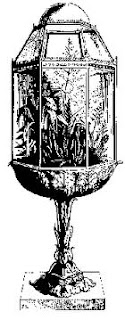
In some ways the cold frame's opposite is the Wardian case. This is a transparent enclosed case that is kept sealed rather than gradually opened. In the early-19th century, Londoners fell victim to a craze for ferns. Ferns of all kinds were hunted from glens and woods in the countryside (some to near extinction) for the sake of urban fashion, to be potted and shown off in Victorian parlors. (To learn more about this, extravagant parlor displays, and the milieu which led to the birth of the modern houseplant, check out Tovah Martin's very interesting book Once Upon a Windowsill.) Unfortunately, this was London of the early Industrial Revolution, choked and benighted by coal smoke, and many ferns promptly crumbled and died.
Nathaniel Ward, a London doctor, was a fern collector and amateur naturalist. He one day collected a moth in a glass jar within which he placed some soil and plants. Though the moth eventually died, Ward noticed that the plants flourished, apparently saved from the "bad air" of London by the sealed nature of the jar. Soon the fern enthusiasts saved their prizes in "Wardian cases" dressed up as elaborate Victorian mini-glasshouses. These cases became little temples of green life in the sooty urban expanse.

The Wardian case not only preserved precious ferns but revolutionized the transportation of plants from one part of the world to another. Since the late 18th century with the world-crossing botanizing expeditions of Joseph Banks on Captain Cook's voyages (the inspiration for Star Trek. Captain Cook = Captain Kirk!), Britain's growing navally-based empire saw the value of moving valuable newly dicovered food crops from one colny to another (Captain Bligh's ill-fated voyage, source of "Mutiny on the Bounty," was meant to ship breadfruit trees from Tahiti to Jamaica for a cheap food source for Caribbean slaves). The stressful months-long sea voyages filled with storms and salt water were nearly always disastrous for plants that were usually potted into barrels, exposed to harsh sea air and winds, and then sometimes even watered by ill-informed shiphands with salt water from the sea when fresh water was a scarce resource.
The advent of the Wardian case changed this by enclosing well-packed plants into large glass cases. The tight seal kept the harsh sea environment out and humidity from plant respiration and soil in. It also was instrumental in the mass smuggling of Chinese tea plants from China to British-controlled India over the Himalayas, effectively breaking the Chinese hold on Britain's tea addiction. Plants could now move across the vast expanses of the Inidan and Pacific oceans back to the metropole of London and the imperial center of plant expeditions, the Royal Botanic Garden at Kew.
The modern descendant of the Wardian case is the terrarium, where plants nestled in a bit of soil in a glass bowl are sealed away. Water is cycled and recycled in the closed environment where tiny ferns, mosses, and club-mosses flourish.
Subscribe to:
Posts (Atom)
